Issue Once,
Verify Forever
Credentials get forged. Records get lost. Verification takes days. Arkova anchors a tamper-evident fingerprint of any document to a public network — the file never leaves your device, but a permanent, independently verifiable proof of it does.
Verification Certificate
Arkova Secure Record
Anchored document
PDF · 5.1 KB
# Document Fingerprint
SHA-256 cryptographic hash · 3c29e6e6…126f7845
Anchor Record
Status
SECURED
Public ID
ARK-DOC-HKUK9N
Network Checkpoint
946,305
Network Observed Time
Apr 22, 2026 · 9:09 AM UTC
Framework Alignment
Frameworks this record maps to — not certifications held.
GET /verify/ARK-DOC-HKUK9N
Tamper-evident — the document never touched our servers, only its fingerprint.
The mechanism
Fingerprint. Anchor. Verify.
Three steps from a document on your device to a permanent proof anyone can check — without ever handing us the file.
Fingerprint
A SHA-256 fingerprint of the document is generated in your browser. The file itself never leaves your device — we only ever see the fingerprint.
Anchor
The fingerprint is anchored to a public network: a permanent, independent reference that no one — including us — can alter after the fact.
Verify
Anyone with the link verifies authenticity in a single call. No phone calls, no registrar offices, no waiting weeks for a transcript.
Privacy is the architecture, not a feature. Fingerprinting happens in your browser with the Web Crypto API. Only a SHA-256 fingerprint is anchored. For documents you upload, the file never leaves your device. Account and billing details you give us are held in our systems and covered by our Privacy Policy. Even if we were breached, your records stay private, because we never had them.
Prove it yourself
Don't take our word for it. Check one yourself.
Every Arkova record has a public ID. Enter one to pull its live, independently anchored proof — issuer, timing, and integrity — straight from the production network. No account required.
Pre-filled with a real record — hit Verify to check it live, or see it on search.arkova.ai. Paste any Arkova public ID — no account needed.
One call in, proof out
Verification in one call
A REST API designed to plug into the stack you already run — SIS, LMS, HRIS, ATS, or an AI agent. Look up any anchored credential or document by its public ID and get back a structured, independently verifiable result.
- Single-call & batch verification (REST)
- Agent-callable over MCP — verify_batch, get_record
- DocuSign & document-source anchoring
- HMAC-signed webhooks & API keys
$ curl https://app.arkova.ai/api/v1/verify/ARK-DOC-HKUK9N

# Click “Run it” to call the live API and see the real response.
Runs the real /api/v1/verify endpoint against a live anchored record.
Public, read-only, rate-limited — no API key required to verify by public ID. Null fields are omitted from the response.
Or get the event pushed to you
Subscribe to lifecycle events and Arkova posts a signed payload to your endpoint the moment a record is secured or verified. Pick an event and deliver a test.
The exact JSON we POST to your server
POST https://your-app.com/hooks/arkova
X-Arkova-Event: anchor.secured
X-Arkova-Signature: sha256=9f2b1c7a4e8d0b63f5a1c9e27d4b0a861d4c8b2f7e0a95c3d6b8f1a4e7c0d9b2

{
  "event": "anchor.secured",
  "data": {
    "public_id": "ARK-DOC-HKUK9N"
    "status": "SECURED"
    "anchor_timestamp": "2026-04-22T09:09:03Z"
    "network_receipt_id": "aa3c65ca38adc017…"
  }
}
Fires when a record finishes anchoring to the public network. Every payload is signed with HMAC-SHA256 so your server can confirm it really came from Arkova.
This is an illustration of the event shape and signing — real deliveries POST to your endpoint, not the browser.
Watch it run
From secured record to independent verification
What an Arkova user sees after a credential, contract, or any other document is secured — and how a third party verifies it on search.arkova.ai with nothing but the public ID. No account required.
For the whole chain
One proof layer, every side of the handoff
From the person who earns a credential to the auditor who has to trust it — everyone works from the same independently verifiable record.
Legal Departments
Timestamp and verify contracts, filings, and evidence with cryptographic proof that survives vendor churn and system migrations — independently checkable years later, without the original file.
Students & Learners
One shareable portfolio of degrees, certificates, CE credits, and recommendations — in a place you control, not scattered across ten issuer portals.
Registrars & Institutions
Turn static records into verifiable links and stop answering verification requests one transcript at a time.
Compliance & Audit Teams
Evidence is anchored as it is created — tamper-evident, dated, and verifiable across the frameworks you operate under. The work shifts from compilation to review.
The trust shift
Trust used to be assumed.
Now it has to be proven.
AI can fake a document in seconds
Convincing forgeries are now trivial to generate. A signature or a logo is no longer evidence — an independent, tamper-evident proof is.
Auditors want cryptographic evidence
Regulators and auditors increasingly expect proof of integrity and timing, not vendor assurances. SOX, eIDAS 2, ESIGN, and UETA are all moving this way.
Verification that needs a vendor alive isn’t verification
When proof depends on one company’s servers staying online, it expires the day they don’t. Arkova proofs outlive the software that made them.
Measured, not asserted
Security you can independently check
Verifiable trust is the product, not a checkbox. Here is exactly what we assert — and what we don't.
CSA STAR Level 1
Self-Assessment · Listed since Jun 2026
Our security controls are documented publicly in the Cloud Security Alliance STAR Registry, mapped to the CAIQ v4.1.0 Cloud Controls Matrix. STAR Level 1 is a published self-assessment — an industry-standard disclosure of our controls, not a third-party audit or certification.
View our STAR Registry listingClient-side by design
Documents you upload are fingerprinted in your browser, and only identifier-stripped metadata is transmitted. We never hold the original file.
SOC 2 Type II in progress
A veteran CISO completed our Business Impact Analysis, the foundational step in our SOC 2 Type II readiness program.
Independently verifiable
Every anchor is a SHA-256 fingerprint committed to a public network. Anyone can verify it without trusting us.
Partners
Who we build with
Customers anchoring real records, identity and authorization layers that call Arkova for the document fact, and the security partner that tests us.
Customer · Legal technology
HakiChain
AI legal tool suite for legal teams in Kenya. Arkova’s first paying customer, anchoring executed legal documents through the Arkova API.
Integration partner · Agent identity
ComputeID
Open standard for cryptographic identity of AI agents, GPUs and models, from the AI Identity and Trust Foundation. Identity above, document proof below.
Integration partner · Digital-finance control layer
Certen Protocol
Hierarchical multi-party authorization for stablecoins, tokenized assets and AI agents. Arkova supplies the verified document and credential fact inside Certen’s approval path.
Security partner · Autonomous pentesting
Sekura AI
Autonomous penetration testing that proves every finding. Sekura provides SAST and DAST scanning and continuous security monitoring for Arkova.
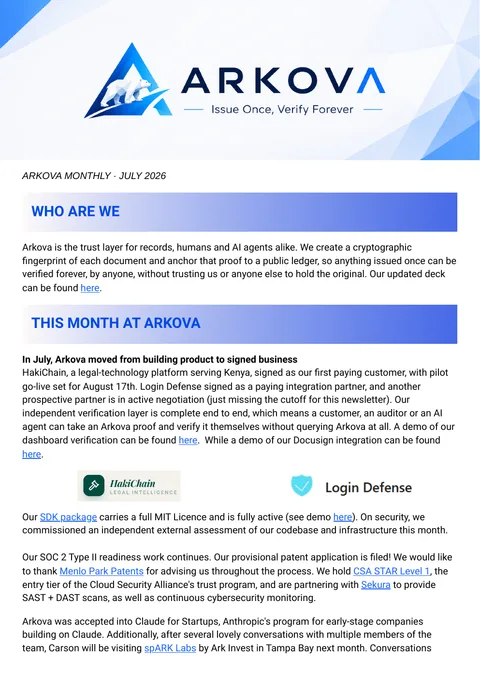
Arkova Monthly
Keep up with what we're shipping
Product, security, and partnership updates — one email a month, no filler. In the July 2026 issue: Arkova moves from building product to signed business: HakiChain signs as our first paying customer, Login Defense signs as an integration partner, and independent verification ships end to end.
Articles
From the team
The Missing Gap in the Agentic IAM Discussion
The identity layer for AI agents is being solved. The document layer underneath it is not. Why the next liability incident will come from what an agent acted on, not who the agent was.
The State of Compliance in 2026: Why More Frameworks Won't Fix the Evidence Problem
Average audit fees for US large accelerated filers reached $6.06M in FY2024, and SOX preparation routinely runs six to twelve months at scale. Meanwhile NIST AI RMF, the EU AI Act, DORA, the SEC cybersecurity disclosure rule, and a wave of state privacy statutes have landed on top of the existing framework stack. The substrate underneath these obligations should be rebuilt to match.
The Rise of the Agentic Economy: How AI Agents Are Becoming Economic Participants
AI agents are no longer just answering questions — they are buying, selling, verifying, and transacting. A $7.3 billion market is racing to build the payment rails, identity systems, and trust infrastructure that autonomous agents need to operate in the real economy.
Why we built this
We built this because verification is broken at every level

Carson Seeger
Founder & CEO
10+ years in technical product and program management across regulated industries. Built Arkova to give organizations verification infrastructure that outlasts any single vendor.
LinkedIn
Sarah Rushton
Founder & COO
Over 20 years launching products through compliance-heavy supply chains taught Sarah one thing: documentation verification is broken at every level.
LinkedIn
Dr. Yaacov Petscher
Founder & Advisor
20 years Research & Data Science experience. Senior Member of the National Academy of Inventors.
Google ScholarAdvisors & team
Jenny Parks
Higher Education Advisor
Over 30 years in higher education and digital credentials, guiding Arkova’s credentialing and professional-licensing work.
LinkedInUyiosa Israel
Business Development Lead, Africa
Leads sales, partnerships and regulatory insight across the continent, starting with the Kenya pilot.
LinkedInWhat skeptics ask
Common questions
What does Arkova actually do?
Arkova creates a permanent, independently verifiable proof of any credential or document. It anchors a tamper-evident fingerprint of the file to a public network, so anyone can later confirm the issuer, the timing, and the integrity — without Arkova ever holding the file.
How is this different from DocuSign, a notary, or a timestamp service?
DocuSign proves someone signed; a notary vouches with their seal — both depend on that vendor or person still being reachable years later. Arkova proves the exact document existed, unchanged, at a specific time, anchored to a public network no single company controls, so the proof survives even if Arkova, DocuSign, or the notary is long gone. It complements e-signature and notarization rather than replacing them: sign or notarize as usual, then anchor the result for permanent, independent verifiability.
Do you store my documents?
No. For documents you upload, fingerprinting happens in your browser and only the fingerprint and minimal metadata are transmitted. For documents pulled from a source you connect, such as DocuSign or Google Drive, the file is fingerprinted in memory on our servers and then discarded immediately; it is never written to our database, logs or storage. Even if we were breached, your documents stay private — because we never had them.
Can my document be reconstructed from the fingerprint?
No. A SHA-256 fingerprint is a one-way function: it maps any file to a fixed 64-character value that cannot be reversed back into the original. It confirms two files are identical without revealing anything about the contents. We can prove your document is authentic; we cannot read, reconstruct, or reproduce it — and neither can anyone who intercepts the fingerprint.
What does “tamper-evident” actually mean?
If a single byte of the original document changes, its fingerprint no longer matches the anchored one and verification fails. Integrity is provable by mathematics, not asserted by us.
What happens if Arkova goes away?
The proof outlives us. Because the fingerprint is anchored to a public network, a record stays independently verifiable even if Arkova’s servers are offline or the platform that issued it shuts down.
What is the “public network” you anchor to?
An open, permanent, widely-replicated public network that no single company — including Arkova — owns or can quietly rewrite. Because the fingerprint is committed there rather than to our servers, anyone can independently check a record without trusting us, and the proof keeps working even if Arkova does not.
How does someone verify a record?
Every record has a public ID. Anyone can look it up — on the Verify page or with a single API call — to see the issuer, the anchor time, and the tamper-evident status. No account, and no access to the original file, required.
Can a record be revoked or corrected after it’s anchored?
The original proof is permanent by design — that’s what makes it trustworthy. But a record also carries a live status (Active, Revoked, Superseded, or Expired), and an issuer can revoke a record or publish a corrected version that points back to the original. Verification always shows the current status alongside the immutable anchor, so you get both an unforgeable history and an up-to-date state.
Can I integrate it with my systems?
Yes. A REST API (single-call and batch), HMAC-signed webhooks, and direct anchoring from sources like DocuSign plug into the SIS, LMS, HRIS, and ATS stacks you already run — with a full audit trail of every call.
Is it available now?
The verification layer runs in production today; the full product is in early access. Join the waitlist and we’ll reach out to scope a pilot.
Proof that travels with the record
Join the waitlist. We'll notify you when early access opens. Have questions? Contact us.
No spam. We'll only email you when we launch.
Investor or partner? View the pitch deck or write to founders@arkova.ai.
Last updated: September 2026